Why AI defaults to category incumbents, and how challengers change the framing
AI engines keep recommending the big brands because the sources they read do. Why incumbents dominate share of voice, and where challenger brands can change the framing.
Short version: AI engines recommend the big brands because the pages they read keep recommending the big brands. It isn't loyalty or a deal. An incumbent has years of reviews, comparisons, forum threads, and "best of" lists naming it as the default. When an engine searches for your category, that's what comes back.
That sounds like bad news for a challenger. It's less bad than it looks, because the pages engines cite aren't only the web's biggest sites, and because "default" is a framing that changes from prompt to prompt. This post explains why the incumbent advantage exists, how to measure it honestly, and where we see room for challengers to move.
How the incumbent advantage works
Picture a category with one established brand we'll call Globex and a younger competitor, Acme. Ask an engine for the best tool in the category and Globex tends to come first. Three things push it there.
Volume of coverage. Globex has been written about for longer, by more people. More pages mention it, so more retrieved pages mention it, so more answers mention it.
Category association. Promptwatch's Academy notes that models lead with the brand they most strongly associate with the query, and that broad coverage pairing a brand with the category pushes it up the order. Years of "Globex, the leading tool for X" phrasing build exactly that association.
Comparison gravity. Challengers get framed relative to the incumbent. "Acme, a cheaper alternative to Globex" names Globex as the reference point even in an answer about Acme. That's a perception problem as much as a visibility one: you're positioned as the alternative, not the answer.
None of this is permanent. All of it comes from pages, and pages change.
Measuring the gap honestly: Share of Voice
The metric that shows incumbent dominance most directly is Share of Voice. Promptwatch defines it as your mentions divided by the total mentions across the brands you compare against, times 100, counted once per brand per response. If engines mention some brand 200 times across your tracked prompts and 50 of those are yours, your Share of Voice is 25%.
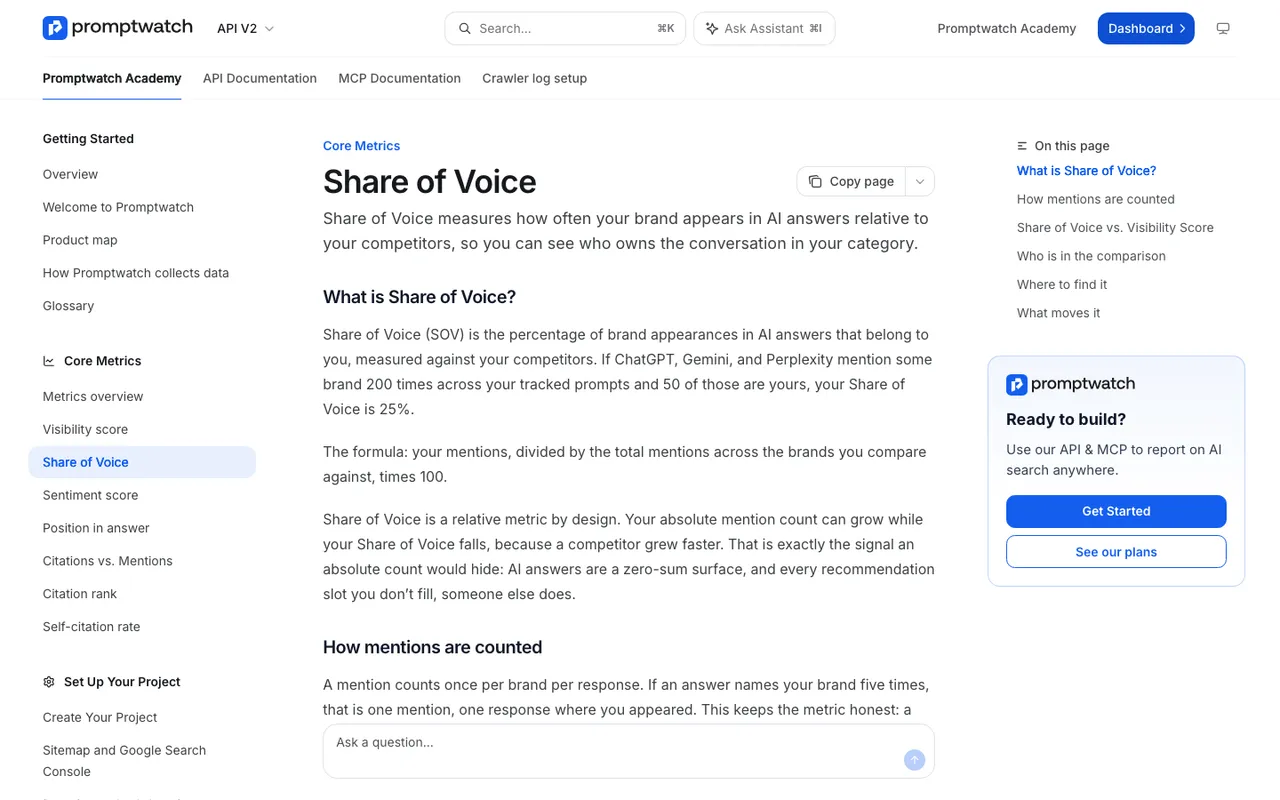 Promptwatch Academy's Share of Voice page, captured November 14, 2026.
Three details matter for a challenger reading this number.
It's relative. Your mentions can grow while your share falls, because the incumbent grew faster. The Academy describes AI answers as zero-sum for this reason: every recommendation slot you don't fill, someone else does.
It depends on who's in the comparison. Adding a competitor adds their mentions to the denominator. Switch from "My brands" to "All brands" and the comparison widens to every brand detected in your responses, which usually lowers everyone's share. Keep the competitor list to brands you actually compete with, or your number describes a market you're not in.
It's presence only. A one-word mention at the bottom of an answer counts the same as the headline recommendation. Read it next to Position and the Visibility Score to see whether you're named as a footnote or as a real option.
Slice before you despair
The blended number is where incumbents look strongest. Cut it and the picture usually changes.
By model. The Academy notes it's common to hold 40% Share of Voice on one platform and 5% on another, and the blended number shows neither. Each engine reads different sources, so the incumbent's grip varies.
By prompt specificity. The Academy's position page notes you can hold position 1 on niche prompts ("best CRM for dental practices") while sitting fifth or sixth on broad ones. Challengers often win the specific prompts first, because the incumbent's coverage is general and the challenger's can be targeted.
By persona. Persona Insights compares visibility per persona against the general audience. An incumbent built for large companies may own the default answer while a challenger already leads for, say, small agencies.
By topic. The Topics page shows Visibility, Citation Share, Avg. Position, Share of Voice, and Sentiment for each topic. Find the topics where you're closest.
What we're looking for is the set of prompts where the default is still up for grabs. That's where the work pays first.
The sources engines cite aren't only the giants
Here's the part that changes the strategy. Promptwatch's report on ChatGPT citation share by domain rank looked at every ChatGPT citation in August 2026 with a known domain rank. Domains ranked DR 46 to 60 took 22.6% of citations and DR 61 to 75 took 23.4%, together almost half. The top tier, DR 91 to 100, fell to about 3% by mid-August and averaged 4.4% for the month, less than DR 0 to 15 at 6.3%.
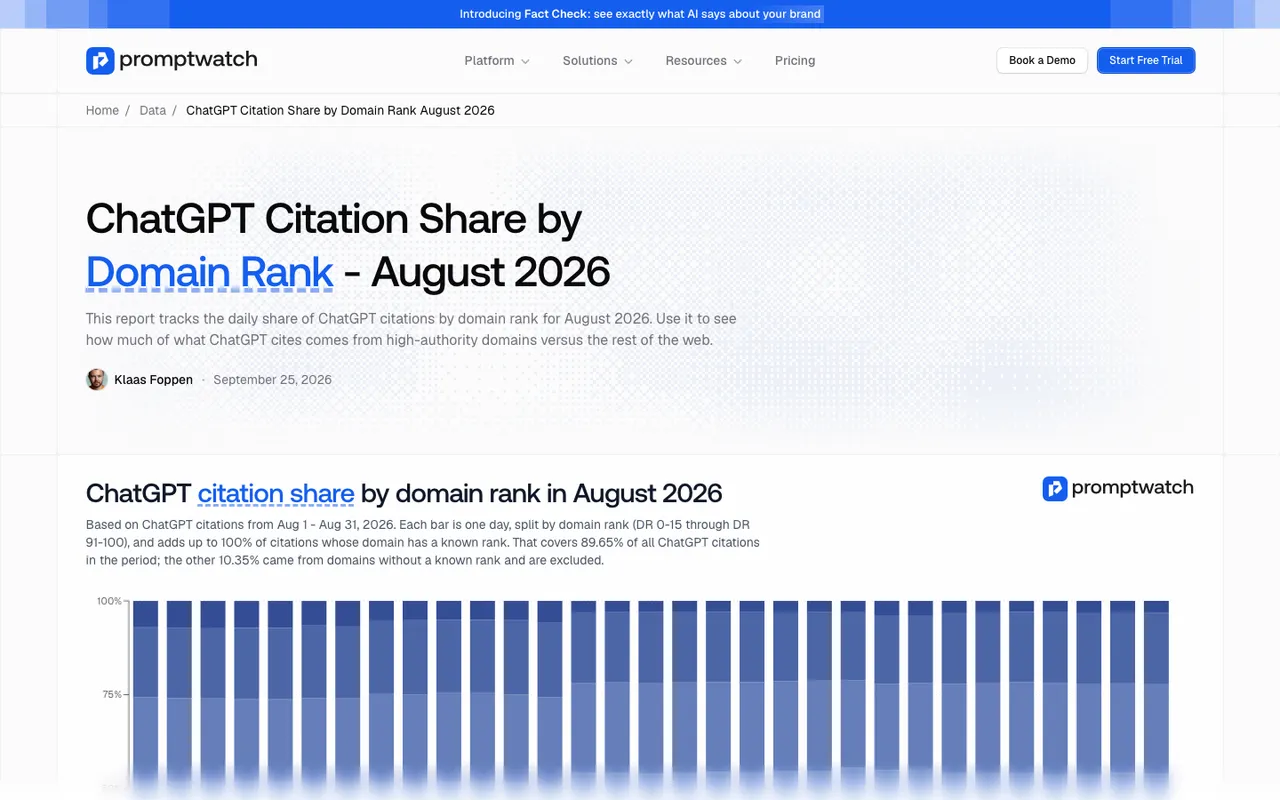 Promptwatch's ChatGPT citation share by domain rank report (August 2026), captured November 14, 2026.
For a challenger, that's encouraging. The pages ChatGPT cites are mostly from mid-authority sites: niche publications, specialist blogs, smaller review sites, industry directories. Those are places a challenger can realistically get covered, accurately and on its own terms. You don't need a feature in the biggest outlet in your industry to be part of the sources an engine reads. The report's own conclusion is that a solid mid-authority site with relevant content is enough to get cited.
This doesn't mean incumbents lose their head start. It means the battle is fought on pages a challenger can reach.
How challengers change the framing
We don't promise challenger clients that they'll replace the incumbent as the default answer. What we work on is moving from "alternative to Globex" to "the right choice for this kind of buyer", one prompt set at a time.
Own a specific frame. Pick the use case, audience, or constraint where you're the better fit, and say it plainly and consistently: on your site, in your documentation, in what you give reviewers. Engines repeat concrete associations. "Built for agencies with ten or more clients" is repeatable. "Modern and flexible" isn't.
Get into the pages already cited. In Citations, look at which domains and pages are cited for the prompts where the incumbent wins. Check their domain ranks against the report above; plenty of the pages engines cite sit in that middle tier. Those are your outreach list: roundups to be included in, directories to complete, review pages to correct. Offsite Mentions shows pages that name you without linking, which are often the easiest to improve.
Publish the comparison yourself. If the only "Acme vs Globex" page is Globex's, you're described in their words. A fair comparison page on your own site, clear about where each fits, gives engines another source to retrieve.
Read the framing, not just the share. Brand Narrative shows the claims engines make about you and the incumbent, grouped by theme, with a Benchmark view of your rank per theme and the gap to the best competitor. A challenger sometimes already wins on a theme like Usability or Support while losing on Reputation. Those winning themes are the frame to build on.
Don't copy the incumbent's positioning. Matching their words makes you a smaller version of them in the answer. Different words give the engine a reason to name you separately.
What to expect
Progress usually shows up first in narrow prompts and individual models, not in the blended Share of Voice. A challenger can lead on a specific use case for months while the headline number barely moves. That's normal, and it's why we report per topic and per model.
Expect the incumbent to keep the broadest prompts for a long time. "Best tool in the category" will keep returning the brand with the most coverage. The question is whether the buyer who asks the narrower question, the one closer to purchase, hears your name and the right reason for it.
We run client programs on Promptwatch because it lets us see share, position, claims, and the cited sources on the same prompts. If you want a first look at where your brand stands against the incumbent, get the free AI Visibility Report. It scans ChatGPT, Gemini, and Perplexity without a login and gives you a visibility score and a crawler access check to start from.