AI search visibility tools for enterprise: a buyer's guide with the vendors' own answers
Buying AI search visibility tools for enterprise? The questions to put to every vendor, what Promptwatch, AthenaHQ, Scrunch and Profound publish in reply, the red flags, and how to run a pilot.
Most enterprise buyers who call us have already sat through three demos. Every demo looked good. Every vendor tracked ChatGPT, Gemini and Perplexity, showed citations and promised "actionable insights". The buyer still couldn't pick, because each demo answered the questions the vendor wanted to answer.
This guide turns that around. It lists the questions we put to vendors when a client asks us to help choose AI search visibility tools for enterprise use, and next to each question, what the vendors publish on their own pricing pages. We read those pages on November 6, 2026. Where a vendor publishes nothing, we say so, because a gap in the public answer tells you how the sales process will go.
A disclosure up front: we run our client programs on Promptwatch. Read our conclusion with that in mind. The questions work for any shortlist.
Before the first call, write down your shape
Vendors gate their plans on a handful of dimensions. If you don't know yours, the vendor picks them for you. Before any demo, put these on half a page:
- How many brands, product lines or domains you track, and whether they need separate workspaces.
- Which countries and languages, and whether any market needs city-level answers.
- Which engines your buyers use. For most B2B teams that means ChatGPT, Google AI Overviews and AI Mode, Perplexity, Gemini and Copilot. Retail teams add shopping results.
- Who opens the tool every week, and who only reads a monthly report.
- What security will ask for: SSO, an audit log, a certification, a data processing agreement.
- Where the data has to land: Looker Studio, a BI tool, a warehouse, Slack.
That half page turns a sales demo into a checklist you control.
The questions, and what vendors publish
1. What's on the price list, and what sits behind "contact sales"?
Enterprise tiers are custom nearly everywhere, so the custom tier itself tells you little. What matters is how much you can see and test before a salesperson gets involved.
Promptwatch publishes three brand plans: Essential at $95 a month, Professional at $245 and Business at $579, with Enterprise priced on request. AthenaHQ publishes a free Essential tier, Starter at $295 a month and a custom Enterprise plan. Scrunch publishes Core at $250 a month plus a custom Enterprise plan. Profound's pricing page shows a free trial and a custom Enterprise package with nothing between them. Conductor's pricing page lists Essentials, Growth and Enterprise tiers with their limits but no prices.
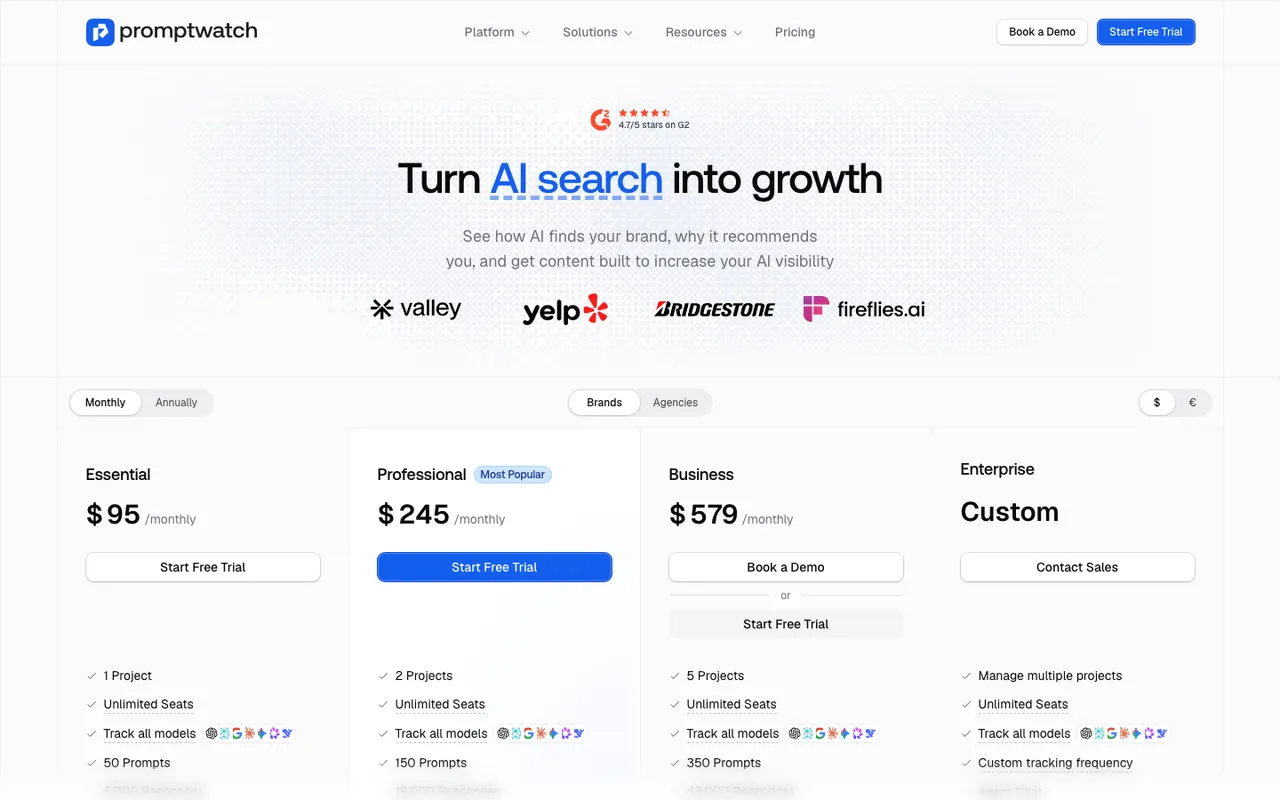 Promptwatch's brand plans in US dollars, captured November 6, 2026.
A custom-only price isn't a red flag by itself. It changes how you test. With a published middle tier you can pilot on real limits and real money. With only a trial and a quote, the pilot is whatever the vendor configures for you.
2. How is usage metered?
Like-for-like comparisons fall apart here, because vendors count different things.
AthenaHQ meters in credits, and its pricing page says one credit equals one AI response; Starter includes 3,600 a month. Scrunch Core includes 125 unique prompts and 5,000 responses a month. Promptwatch lists prompts and responses side by side: Professional has 150 prompts and 18,000 responses, Business 350 prompts and 42,000 responses. Profound's trial runs 50 prompts daily for seven days, and its AI Marketer agents run on credits.
Do the arithmetic before you sign. A response is one engine answering one prompt once. Multiply prompts by engines by runs per day by thirty, and hold that against the allowance. Take Scrunch Core as a worked example: 125 prompts on four engines every day would be 15,000 responses a month, three times the 5,000 included, so ask what cadence the plan assumes. Ask every vendor the same question in the same words: at our prompt count, on our engines, at the frequency we want, what do we pay?
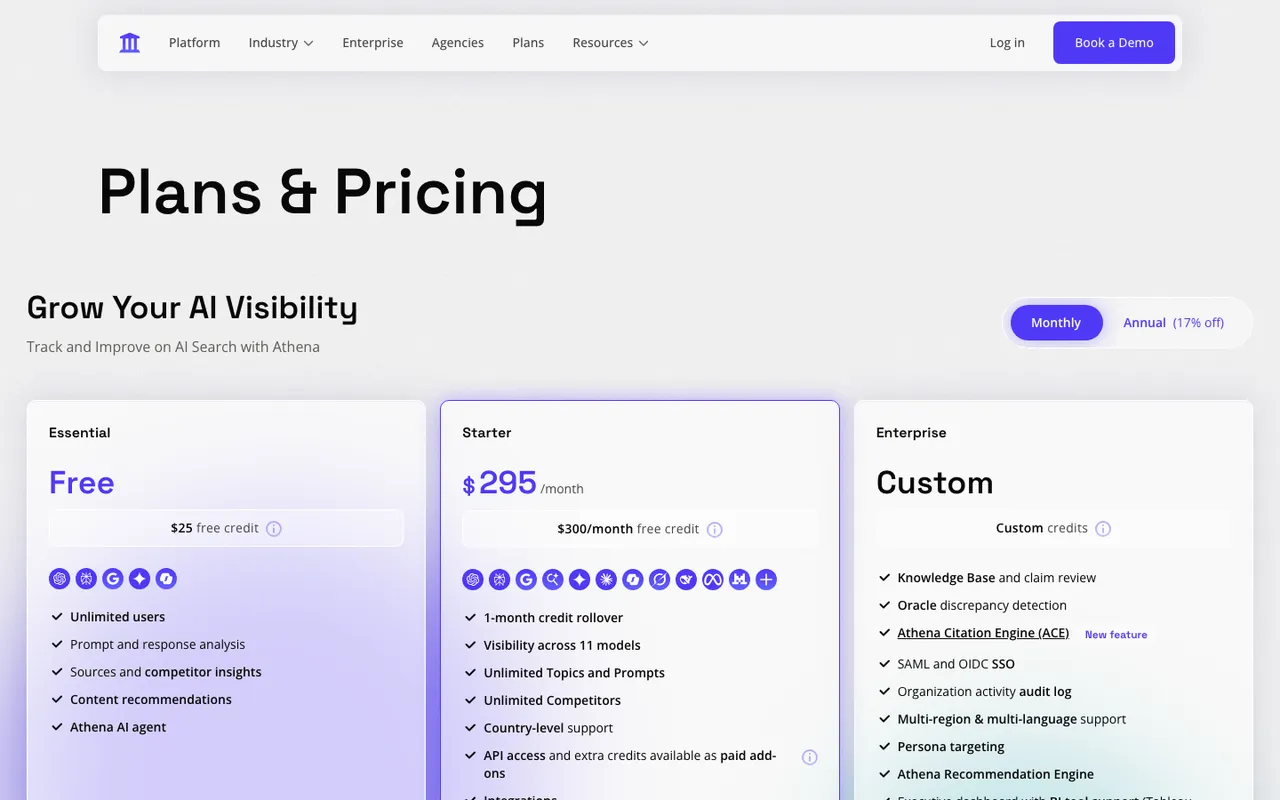 AthenaHQ's plans, where one credit equals one AI response, captured November 6, 2026.
3. Which engines, and how is each one collected?
"Tracks nine engines" can mean two different measurements. Either the vendor reads the live consumer product your buyers use, or it queries the model's API, which answers from training data and often differs from what the product shows. Both are useful. They aren't interchangeable.
Promptwatch spells this out. It monitors the real interfaces of ChatGPT Search, Google AI Overviews, Google AI Mode, Gemini, Perplexity, Microsoft Copilot, Amazon Alexa and Meta AI, and tracks Claude, DeepSeek, Mistral, Grok and several others through their APIs. AthenaHQ's Starter lists visibility across 11 models. Scrunch Core covers four (ChatGPT, Perplexity, Google AI Overviews and Copilot) and its Enterprise plan nine. Profound's Enterprise package says up to nine answer engines. For each of them, ask which engines are read from the real interface and which from an API.
4. How many markets and languages, at which tier?
Global brands get caught here more than anywhere. AthenaHQ's Starter supports a single region and language, with multi-region and multi-language support on Enterprise. Scrunch Core covers one country, one language and one persona. Promptwatch includes country-level tracking on every paid plan, state and city tracking from Business, and coordinate-level local targeting for ChatGPT, AI Overviews and AI Mode on Business and Enterprise.
One detail to plan around: a Promptwatch monitor's language and location are fixed once it's created. That's the right call, since one panel mixing markets produces numbers nobody can read, but it means you design the market structure before setup, not after.
5. What will security get, on which plan?
Get the answer in writing with the plan name attached.
Promptwatch states it is ISO/IEC 27001 certified and GDPR compliant, with data handled by an EU-based company. SSO is on Enterprise. The audit log comes with Business and Enterprise (and Agency Scale), is visible to owners, and records whether each change came from the dashboard, the API, an MCP client or Agent Chat. Roles are owner, editor and viewer with project-level access, and API keys can be scoped to one project, the organization, or read-only.
AthenaHQ's Enterprise plan lists SAML and OIDC SSO and an organization activity audit log, and its footer links a trust center with SOC II and GDPR pages. Scrunch includes Google sign-in on Core and SAML and OIDC SSO on Enterprise. Profound's Enterprise package lists SSO/SAML and SOC 2 compliance.
6. Can it see AI crawlers, and tell an access problem from a content problem?
A brand that isn't cited has one of two problems. The engine can't reach the page, or it reaches the page and doesn't use it. A tool that only replays prompts can't tell you which.
Promptwatch's Agent Analytics logs AI crawler visits, checks them against each operator's published IP ranges so spoofed user agents drop out, and shows a citation rate per page. It starts on Professional. Scrunch lists AI agent and bot traffic on Core. Profound's pricing page lists Agent Analytics with integrations for Cloudflare, Akamai, AWS, Fastly and others. AthenaHQ's page lists smart robots.txt and llms.txt management. In the demo, ask each vendor to show one of your own pages that gets crawled and never cited.
7. Can it connect visibility to visits and conversions?
Leadership will ask this in the first quarterly review. AthenaHQ lists Google Analytics and Search Console integrations. Promptwatch runs its own visitor analytics, installed with a script, a Google Tag Manager template or the WordPress plugin, and reports AI-referred visits and conversions per engine.
Then ask about ChatGPT specifically. On October 8, 2026 ChatGPT stopped sending a referrer. Promptwatch added a toggle that counts utm_source=chatgpt.com visits as ChatGPT again, with a real referrer winning so nothing is double counted. A vendor that hasn't heard about the change isn't watching attribution very closely.
8. How does the data get out?
Promptwatch includes a REST API and an MCP server on every paid plan, with limits from 500 requests an hour on Essential to 50,000 on Enterprise, plus a Looker Studio connector from Professional. AthenaHQ sells API access as a paid add-on on Starter and lists an executive dashboard with Tableau, Power BI and Looker support on Enterprise. Scrunch puts Looker Studio access and its query API on Enterprise. Profound lists API access and CSV and JSON exports on Enterprise, not on the trial.
9. How many people can log in?
Seats look minor until procurement counts them. Promptwatch, AthenaHQ and Profound all state unlimited seats. Scrunch Core includes five user licenses.
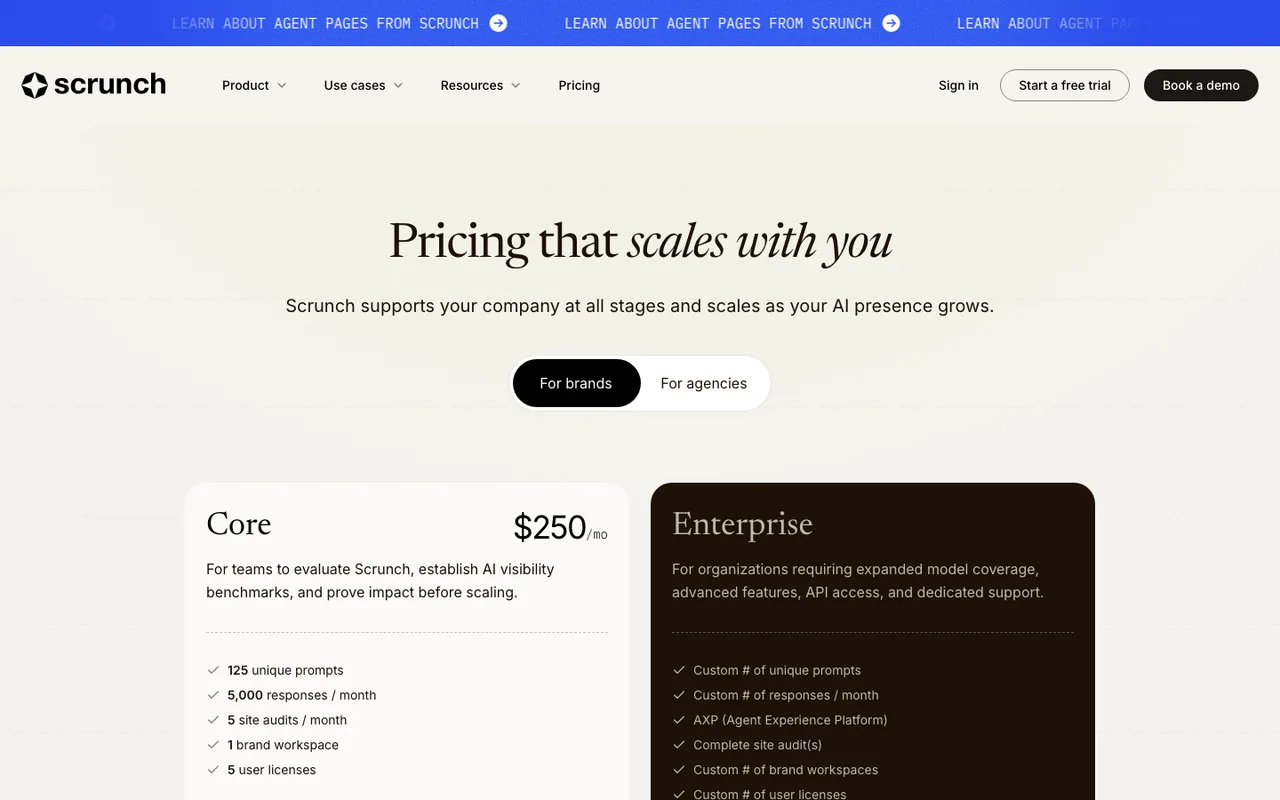 Scrunch's Core and Enterprise plans for brands, captured November 6, 2026.
Red flags
Some answers should slow a deal down:
- The vendor can't show the raw responses behind a score. A visibility number you can't trace to real answers is an opinion.
- Nobody can say how often a prompt runs, or how many times. Without that you can't judge whether a three-point move is signal or noise.
- The prompt set belongs to the vendor and you can't edit it. Pre-built indexes help with research, but your own buyer questions have to be tracked too.
- Security answers come back as "yes" with no plan named. SSO on Enterprise only is fine. Discovering that after you signed the lower tier isn't.
- The product has only ever been shown on a demo account. Ask to see your own domain before the contract.
- A vendor calls itself the top platform and can't tell you who ranked it.
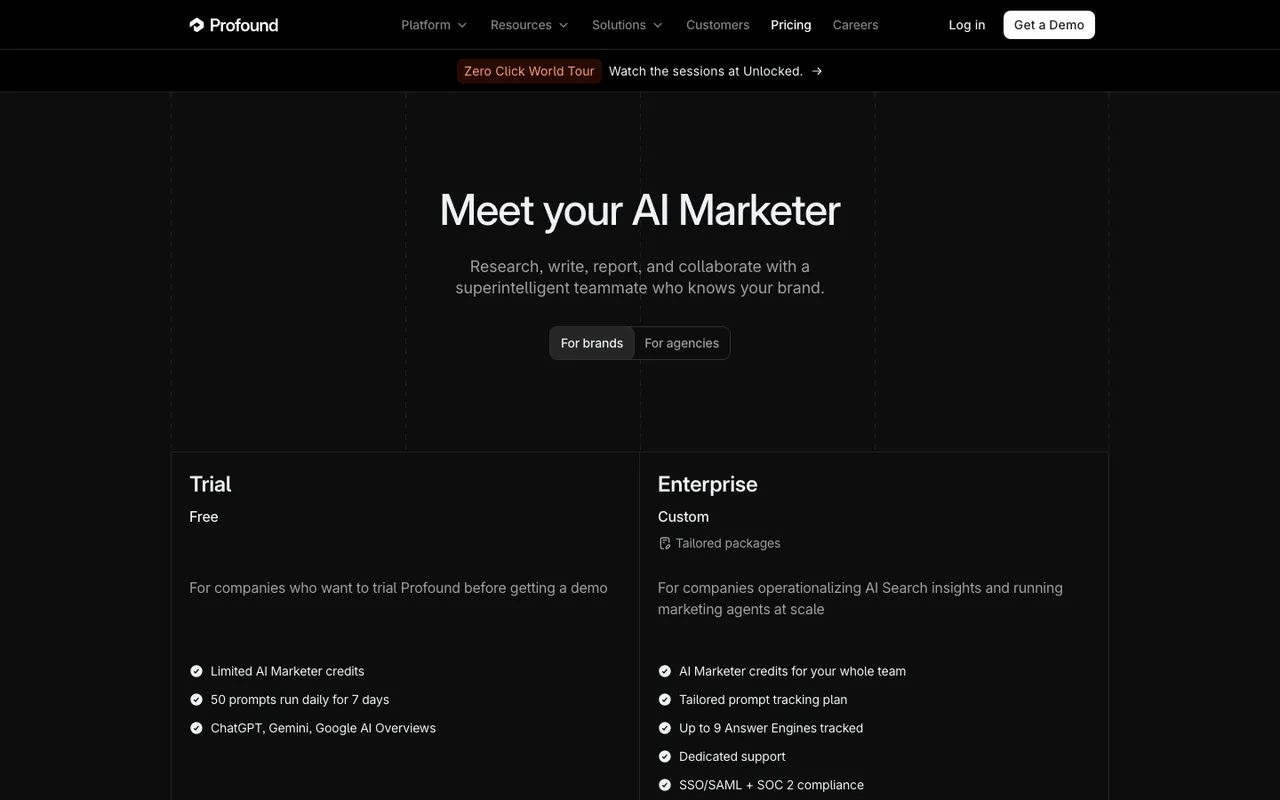 Profound publishes a trial and a custom Enterprise package, captured November 6, 2026.
How to run a pilot that means something
A pilot should answer one question: can our team act on this tool's output and then see the result in it? This is the shape we use with clients.
Setup week. Write 60 to 100 prompts per market. Split them between unbranded category questions, comparisons with named competitors and a smaller share of branded questions, and tag them by topic. Load the same set into each shortlisted tool. Ask IT to connect crawler logs for at least one domain now. In an enterprise that's the step most likely to stall, and you want to find out during the pilot, not after signing.
Weeks one and two, compare. Check ten prompts by hand in the live engines. Do the tools match what you see? Do they match each other? Write down where each tool says the citations point.
Weeks three and four, act. Choose three pages that matter and are crawled but not cited, or where competitors get cited and you don't. Change them. Then watch whether the tool shows crawl activity, citation changes and visits on those exact URLs.
Agree what success means before the pilot starts: data your analysts trust, one change shipped and measured, a clean security review. A tool that can't get you there in a month rarely gets there in a year.
Promptwatch's free trial is seven days on monthly billing. That's enough to judge data quality and setup effort but not the full cycle above, so run the rest on a monthly paid plan or agree an Enterprise evaluation with their sales team.
Where we land
For most enterprise teams we recommend putting Promptwatch first in the pilot. The deciding factor is what happens after the dashboard. Prompts, citations, IP-verified crawler logs and AI-referred visits sit in one place, and so do the Action Board and content work, so a pilot can actually reach the "change a page and measure it" stage. AthenaHQ and Scrunch are the next two we'd load in parallel: AthenaHQ for its action workflow, Scrunch if serving optimized pages to AI agents through its Agent Experience Platform is the lever you want. Profound suits enterprises buying a broader marketing-agent program in which AI search is one channel of several.
If you want a second pair of eyes on the pilot design, write to hello@visiblyrank.com. Otherwise, take your half page of requirements to a Promptwatch demo and work through the nine questions on your own domain.