GEO tools for enterprise: the AI-search-only stack, and why one platform beats four
Which GEO tools does an enterprise need for prompts, citations, AI crawler access, attribution and content? Our AI-search-only stack, where specialists still fit, and why one platform beats four point tools.
When an enterprise client asks us to draw their GEO stack, they usually expect five logos joined by arrows. What we draw has one platform in the middle, a couple of specialists at the edges, and the client's existing analytics and CMS on either side.
That is deliberate. This post walks through the five jobs an enterprise needs GEO tools for, what each job really requires, and why we run them on one platform instead of four. It covers AI search only. Your classic SEO suite, rank tracker and link work can stay as they are; none of that is what decides whether ChatGPT names you.
The five jobs
Think in jobs first and tools second. Every enterprise AI search program we've run needed the same five.
Prompts: what buyers ask, and whether you appear
You need three things here. First, research: which questions people actually put to AI engines in your category, roughly how often, and how hard they are to win. Second, tracking: the same prompts asked of the real engines on a schedule, per market and language, with your position and your competitors'. Third, structure: topics, personas and tags so a global team can slice the numbers without a spreadsheet.
In Promptwatch that's Prompt Volumes (monthly volumes, difficulty scores and citation rates across AI search, Google and Bing), Prompt Explorer (suggestions pulled from Search Console, your ranking keywords, People Also Ask or any page on your site), and monitors that run daily, or every 12, 6 or 1 hours on Business and Enterprise. Query fan-outs show the sub-queries each model ran before it answered, which is often where the content gap really is. Personas can be stacked, so you can track how a CFO in Germany hears a different answer from a developer in the US.
There is one specialist we take seriously here. Evertune comes at the problem like market research. Its homepage says it samples each prompt 100 times across every model, and grounds its prompt strategy in EverPanel, a panel of more than 150 million user prompts. Brand and insights teams that need perception data defensible in a boardroom sometimes want that on top. Evertune publishes no prices and sells through demos.
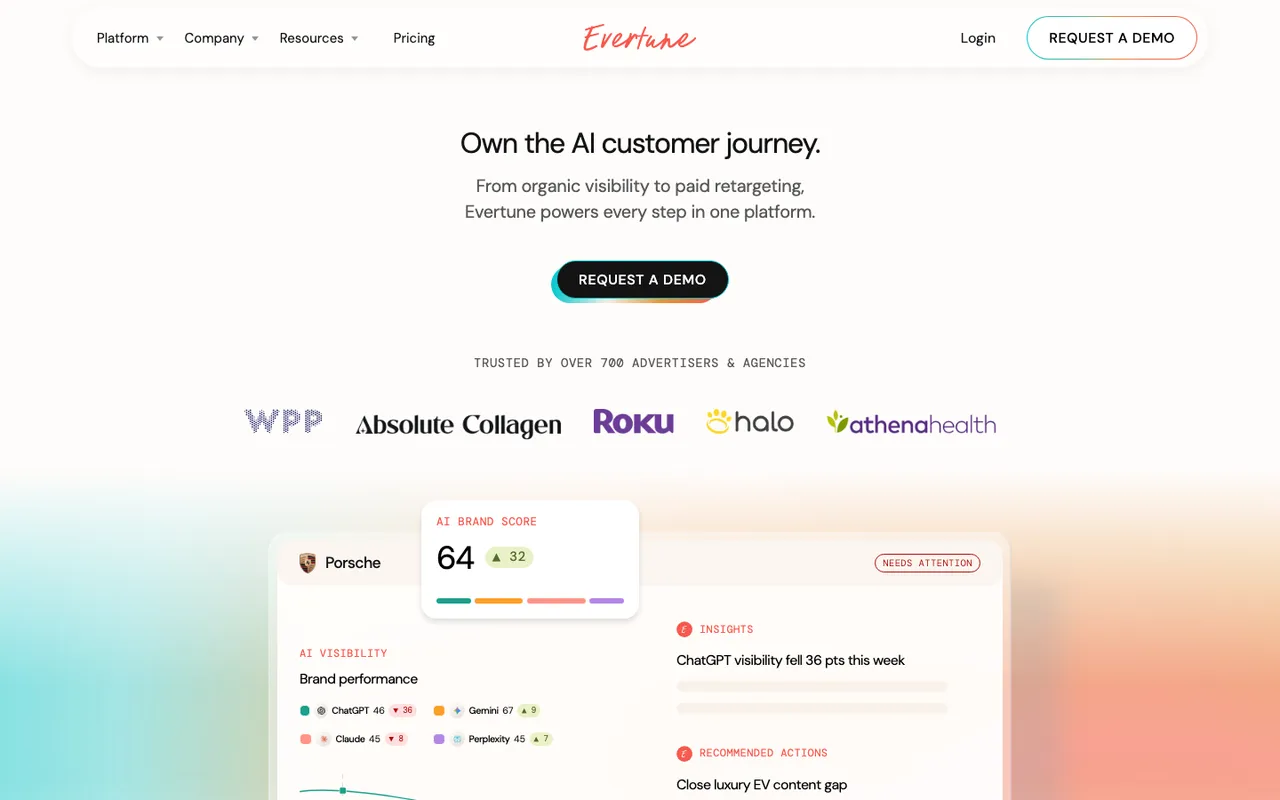 Evertune pitches research-grade sampling for brand teams, captured November 6, 2026.
Citations: where the answers come from
Mentions tell you that you were named. Citations tell you which pages the engine relied on, and those pages are what you can actually change or pitch.
An enterprise needs citation data at URL level, split between your own domains and everyone else's, with social sources broken out and trends over time. Promptwatch covers this with All Citations, URL Positions and Citation Trends, which classify each citation into 22 content types and 20 source types, plus Page Tracker for following specific URLs (yours or a competitor's). Reddit, YouTube, LinkedIn and Instagram each get their own citation report, and offsite mentions list third-party pages that name you without linking.
The trend view matters more than people expect. Promptwatch's own data shows Reddit's share of ChatGPT citations fell from about 4% to about 0.5% on August 14, 2026 (Promptwatch data reports). A PR or community plan built on last quarter's source mix can go stale overnight.
Crawler access: can the engines read you at all
This is the job most enterprises skip, and it's where we find the cheapest wins. AI engines send several bots: training crawlers such as GPTBot, search indexers such as OAI-SearchBot, Claude-SearchBot and Meta-WebIndexer, and user-triggered fetchers such as ChatGPT-User and Perplexity-User. Any of them can be blocked by an old robots.txt rule, a WAF policy or a bot-management setting nobody in marketing knows exists.
You need IP-verified logs per bot and per page, errors with reasons, and a link from crawl to citation. Promptwatch's Agent Analytics verifies visits against each operator's published IP ranges, so spoofed user agents drop out, and shows a citation rate per page. That one number separates an access problem (not crawled) from a content problem (crawled, not cited). Agent Analytics starts on Professional.
Enterprise logs live at the CDN, so integration is the real question. Promptwatch takes logs from Cloudflare (Logpush or an auto-deployed Worker), AWS CloudFront through Kinesis Data Firehose, Fastly, Vercel and Netlify log drains, Akamai DataStream 2, Google Cloud CDN, a custom HTTP endpoint, or its WordPress plugin.
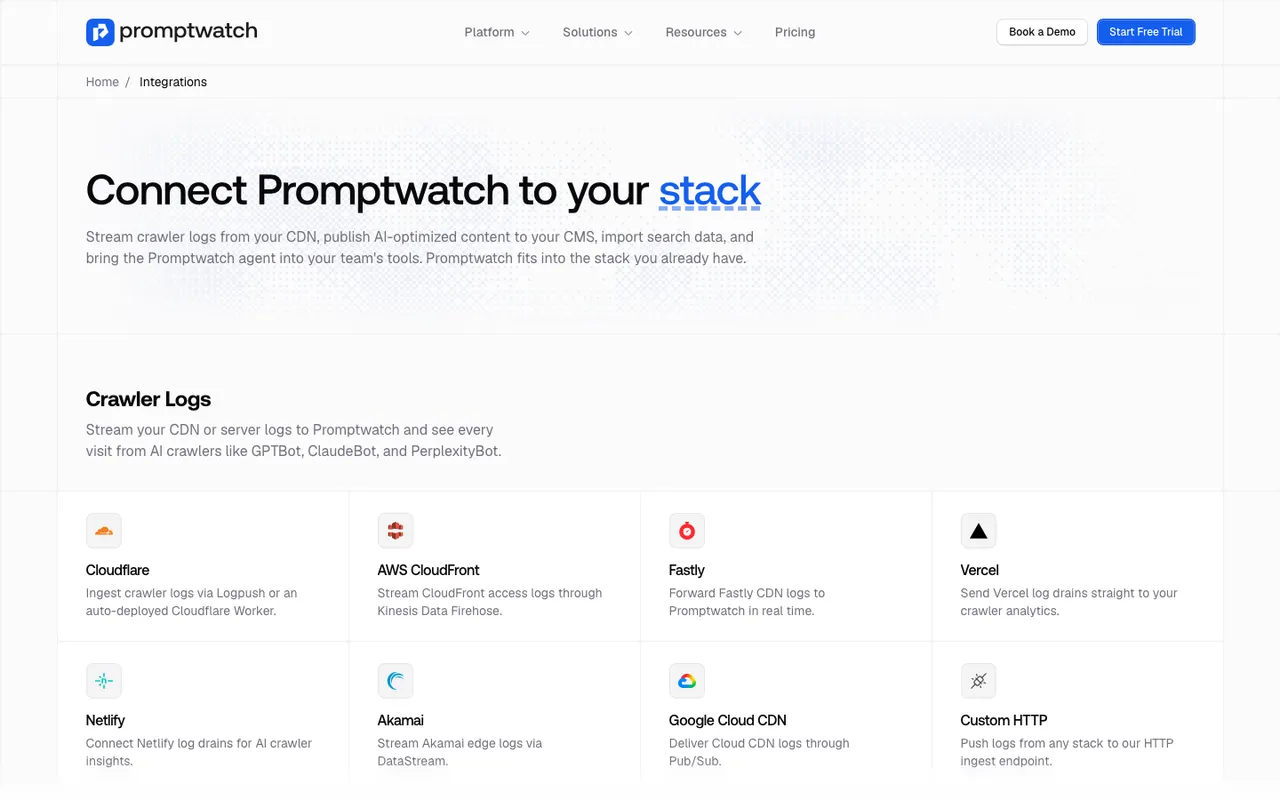 Crawler log integrations on Promptwatch, captured November 6, 2026.
The specialist at this edge is Botify, and it does a different job. Botify is delivery infrastructure: its homepage talks about serving your content to agents in under 300ms and rebuilding product feeds for Google and OpenAI. If your catalog renders in JavaScript and agents see an empty shell, that's a rendering problem, and a monitoring tool won't fix it. Botify doesn't publish prices.
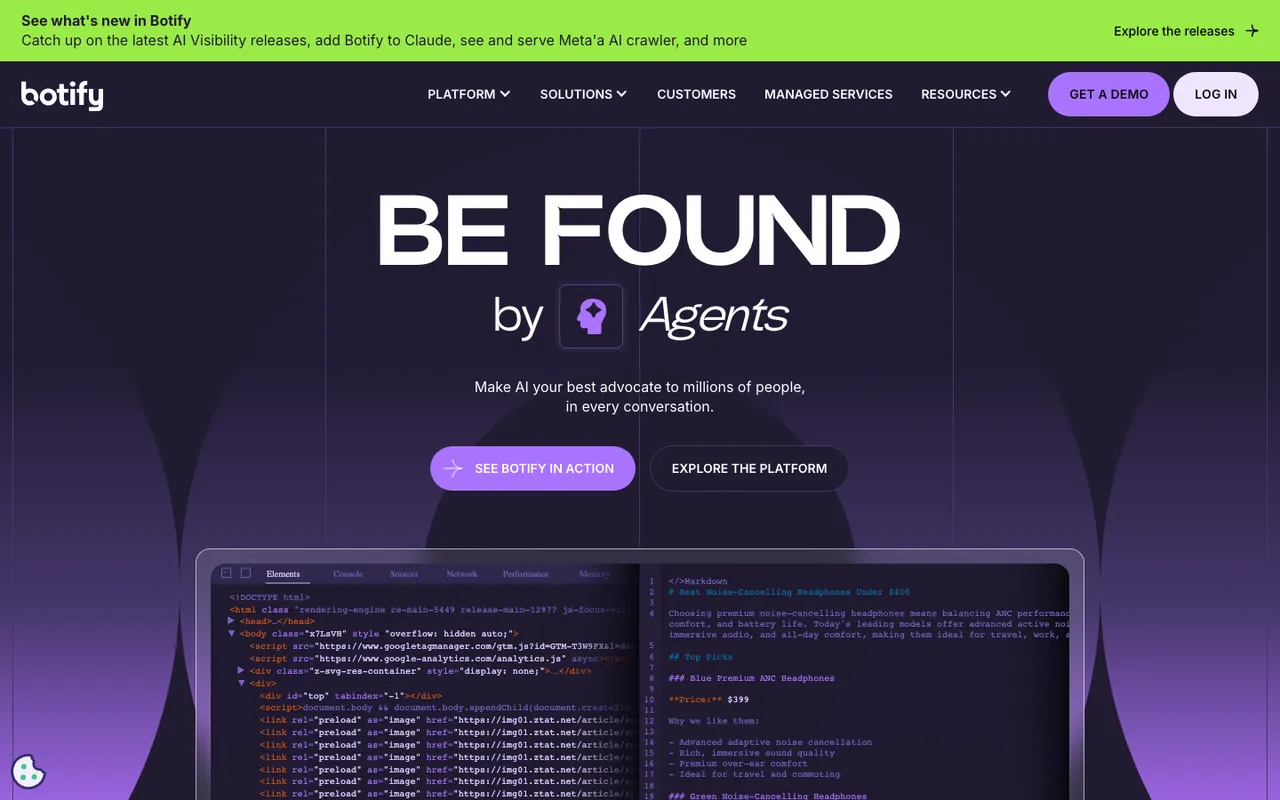 Botify positions itself as the layer that delivers content to AI agents, captured November 6, 2026.
Attribution: what AI search sends you
Leadership will judge the program on visits and revenue, and standard web analytics undercounts AI traffic. On October 8, 2026 ChatGPT stopped sending a referrer, so its visits fell into direct traffic for many sites.
Promptwatch's visitor analytics reports AI-referred visits and conversions from ChatGPT, Perplexity, Gemini, Claude, Copilot (including Microsoft 365 Copilot), DeepSeek and others, and a toggle counts utm_source=chatgpt.com visits as ChatGPT again. Search Insights puts Google Search Console and Bing Webmaster data next to AI crawls, citations and clicks per page and topic, which means classic search and AI search are compared on the same URLs.
Two published Promptwatch case studies show why this is worth setting up. For Crisp, AI-referred traffic converted at twice the rate of traditional channels. For TreeHouse (Pararius, Huurwoningen.nl), AI search grew to about a quarter of organic conversions, 99% of it from ChatGPT, after the team fixed crawler access, published proprietary rental data and automated weekly reporting through the Promptwatch MCP. Those are their results, not a forecast for yours.
Content: closing the gaps
The last job is producing and refreshing pages that answer the prompts you lose. Promptwatch's content gap analysis scores coverage on every plan. AEO articles start on Professional. The automated Content Agent, which plans, writes and publishes against visibility gaps on a schedule with a review inbox, is on Business and Enterprise, and Enterprise adds managed content workflows. Content Refresh suggests diff-style edits to existing pages, and publishing goes to WordPress, Webflow or Framer.
For regulated enterprises, accuracy is part of content too. Brand Narrative pulls out the individual claims AI makes about you and your competitors. Fact Check, on Business and Enterprise, checks a claim against pages crawled from your own site and quotes what it finds.
Why one platform beats four point tools
You could cover the five jobs with a prompt tracker, a log analyzer, an analytics setup and a content tool. We've inherited stacks like that. Here's what goes wrong.
The join is the work. Every useful question crosses jobs. "Why did we drop out of this prompt in Germany?" needs the prompt, the URLs that got cited instead, whether bots crawled your page that week, and whether visits fell. With four tools that's four IDs, four date ranges and an analyst in a spreadsheet. In one platform it's a filter.
The loop closes. After a page goes live, Promptwatch follows it through AI crawls in Agent Analytics, citations in Page Tracker, and visits in visitor analytics. Pages that underperform come back as Action Board items and Content Refresh suggestions. With point tools, the loop stops wherever the hand-off breaks.
Procurement happens once. Each vendor means a security questionnaire, a data processing agreement and an SSO integration. Promptwatch states ISO/IEC 27001 certification and GDPR compliance, with data handled by an EU-based company, and every paid plan has unlimited seats. One review, one contract.
One set of numbers. Two trackers that sample the same prompts differently will report different visibility. Then the quarterly review turns into an argument about which tool is right instead of what to do.
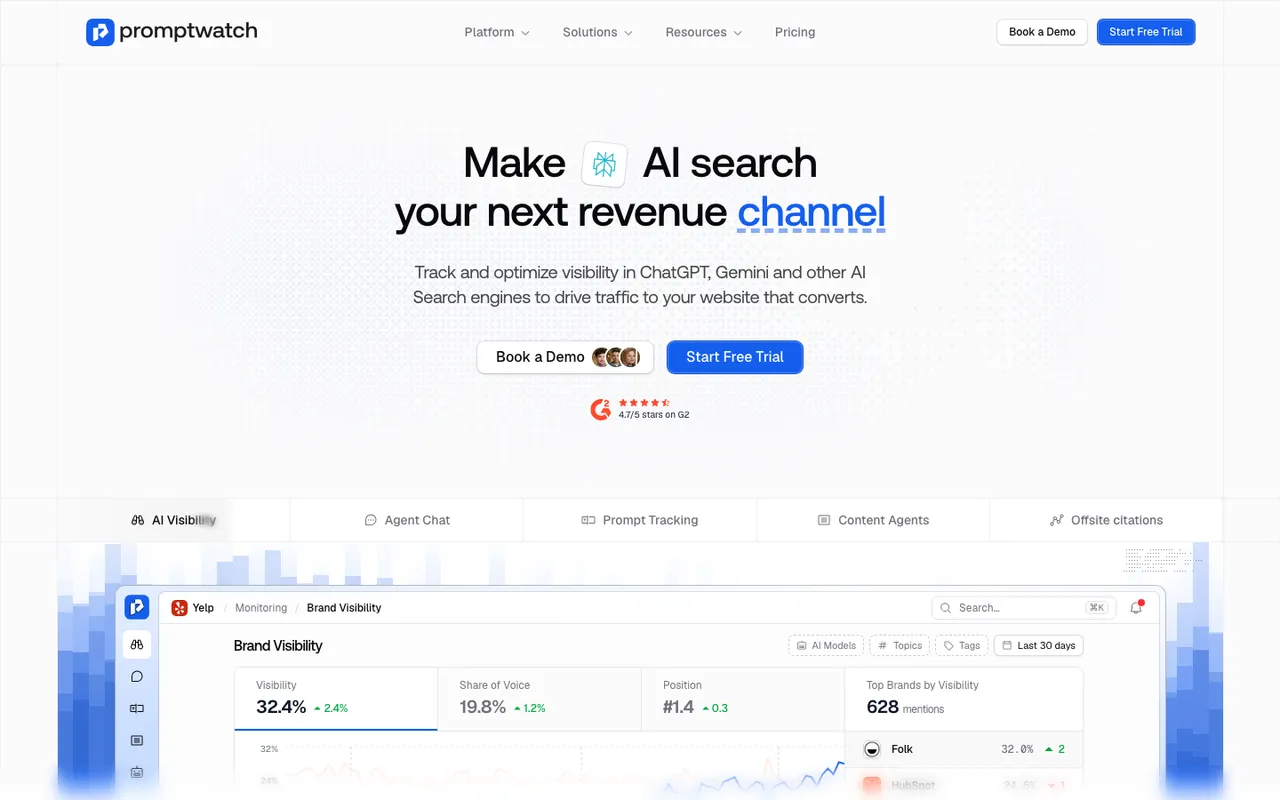 The Promptwatch homepage with its example brand dashboard, captured November 6, 2026.
Where specialists still earn a place
One platform in the middle doesn't mean one tool in total. We keep specialists for three cases:
| Job | Core platform | Add a specialist when |
|---|---|---|
| Prompts | Promptwatch monitors, Prompt Volumes, fan-outs, personas | A brand team needs research-grade perception sampling (Evertune) |
| Crawler access | Promptwatch Agent Analytics | JavaScript rendering or product feeds are the bottleneck (Botify) |
| Attribution | Promptwatch visitor analytics and Search Insights | Finance wants AI numbers inside the company BI tool |
| Citations and content | Promptwatch citation reports, Content Agent, CMS publishing | Your editorial workflow has to stay in its current system |
For the BI case, Promptwatch's REST API, MCP server (110+ read and write tools) and Looker Studio connector (from Professional) feed the data out, so the specialist stays at the edge and reads from the center.
Which plan an enterprise lands on
Most enterprise programs we run start on Business or Enterprise. Business at $579 a month adds what a larger team needs day to day: five projects, 350 prompts, tracking up to hourly, state and city tracking, the automated Content Agent, Fact Check and the audit log. Enterprise is custom and adds SSO, custom volumes, managed content workflows, a dedicated success manager, priority support and 50,000 API requests an hour.
If you want to see the stack on your own domain, book a Promptwatch demo and ask them to show one page all the way from prompt to crawl to citation to visit. If you'd rather have us run it, write to hello@visiblyrank.com.