Tracking AI perception shifts after a product launch
How long until AI knows about your new product, and why the old description lingers. Our launch tracking plan: baseline, topics, citations, and claims over time.
Launch week goes well. The announcement is out, the press picked it up, the new product page is live. Two weeks later, someone on the team asks ChatGPT about the company and gets a description of the product as it was before launch, missing the new feature and still repeating the old limitation the launch was meant to fix.
"How long until AI knows about my new product?" is the question we hear around nearly every client launch. The honest answer is that nobody can give you a date. What we can give you is a way to see the shift as it happens, model by model, and a sense of why the old description hangs on.
Why there is no single answer
Not every engine learns about you the same way. Promptwatch's Academy describes two groups of models, and they behave very differently after a launch.
Live-search platforms, such as ChatGPT with search, Perplexity, Gemini, Copilot, Google AI Overviews, and AI Mode, build answers from pages they retrieve at the moment someone asks. They can reflect your launch as soon as they retrieve a page that describes it. That depends on their indexes having your new pages, and on those pages being retrieved for the question.
API models, such as DeepSeek and Mistral, are tracked to show what the model itself believes about your brand from training data, independent of today's search results. They won't know about a launch until a future version is trained on material that includes it. You don't control that schedule, and neither does anyone selling you GEO services.
So the realistic picture after a launch is uneven. Some engines may describe the new product within weeks; others may keep describing the old one for much longer. Tracking by model is the only way to see which is which.
Why the old description lingers
Even on live-search engines, the old story has an advantage: the pages that carry it are established. Promptwatch's content half-life report followed every page ChatGPT cited on July 6, 2026, for 90 days, split by content type. Landing pages and documentation held up best. After 30 days, ChatGPT still cited 78% of the landing pages and 76% of the docs from day 0, and after 60 days 69% and 67%.
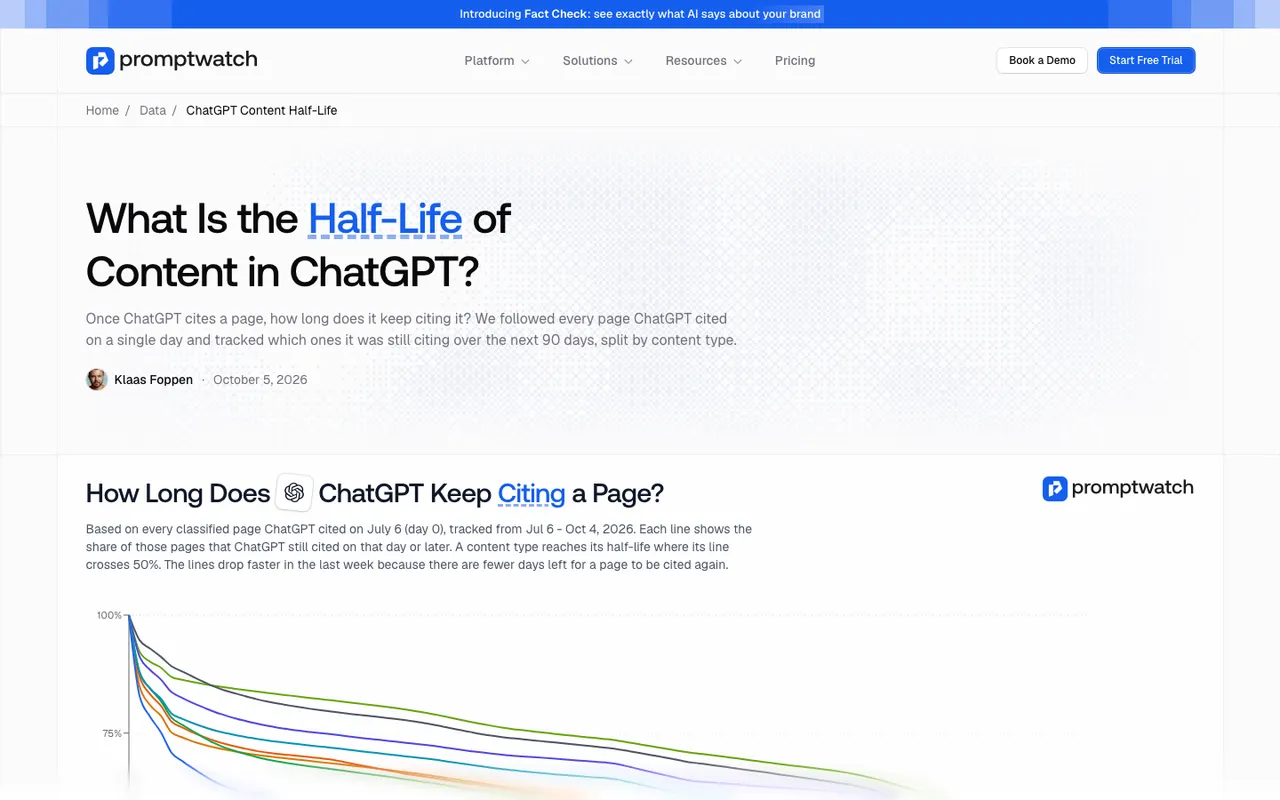 Promptwatch's ChatGPT content half-life report, captured November 14, 2026.
News went the other way. Almost a quarter of news pages were never cited again after day 0, half were gone after 36 days, and by day 60 ChatGPT still cited 41% of them.
Put those two findings next to a launch and the problem is obvious. Your launch coverage is news, and it fades fast. Your existing landing pages and docs, which describe the product as it was, keep getting cited for months. If you launch without updating them, the long-lived pages keep telling the old story while the short-lived ones tell the new one.
That's the most practical takeaway we draw from the report for launches: update the durable pages on launch day, not just the announcement.
Before launch: set the baseline
You can't see a shift without a before. Two to four weeks ahead of launch, we set up the following for clients.
A topic for the new product. In Promptwatch, the platform we run client programs on, topics group prompts, and the Topics page shows how your brand does in each one. Create a topic for the launch so its prompts can be read together.
Prompts the new product should answer. Three kinds. Category prompts where the new product should now appear ("best tool for X"). Capability prompts about your brand ("Does Acme do X?"). And comparison prompts against the competitors the launch is aimed at. Write them in buyers' words.
A note of the claims you want to change. Open Brand Narrative and write down the current claims under Features and any other theme the launch affects. If engines say "Acme lacks X" and the launch adds X, that's your clearest before-and-after signal.
Tracking on the new and updated pages. Add the pages to Page Tracker so you can see when and where they're cited.
Leave the prompt set alone once it's running. Adding prompts mid-launch changes the denominator and muddies the comparison.
Launch day: update what lasts
The half-life data argues for spending launch-day effort on pages with staying power. Our list:
- The main product or landing page, so it states the new capability in plain words near the top.
- Documentation, including a page specific to the new feature.
- The pricing page, if plans or limits changed.
- Existing comparison pages, which the report also found to hold up well (72% still cited after 30 days).
- Any help article that describes the old limitation. Update it to say what changed.
Then check that engines can read the new pages. Agent Analytics (from Professional) shows IP-verified AI crawler visits per page, so you can see whether search indexers like OAI-SearchBot have fetched the new product page, and whether user-triggered fetchers like ChatGPT-User pull it into answers.
After launch: read the shift
We check four things weekly for the first couple of months.
The Topics page. Since an October 26 update, Topics has its own page with five brand metrics per topic and per prompt: Visibility, Citation Share, Avg. Position, Share of Voice, and Sentiment. Citation Share is the one we watch most after a launch. It's the citations of your own sites divided by all citations in the topic's answers, so a rise means engines are increasingly building answers in the launch topic from your pages.
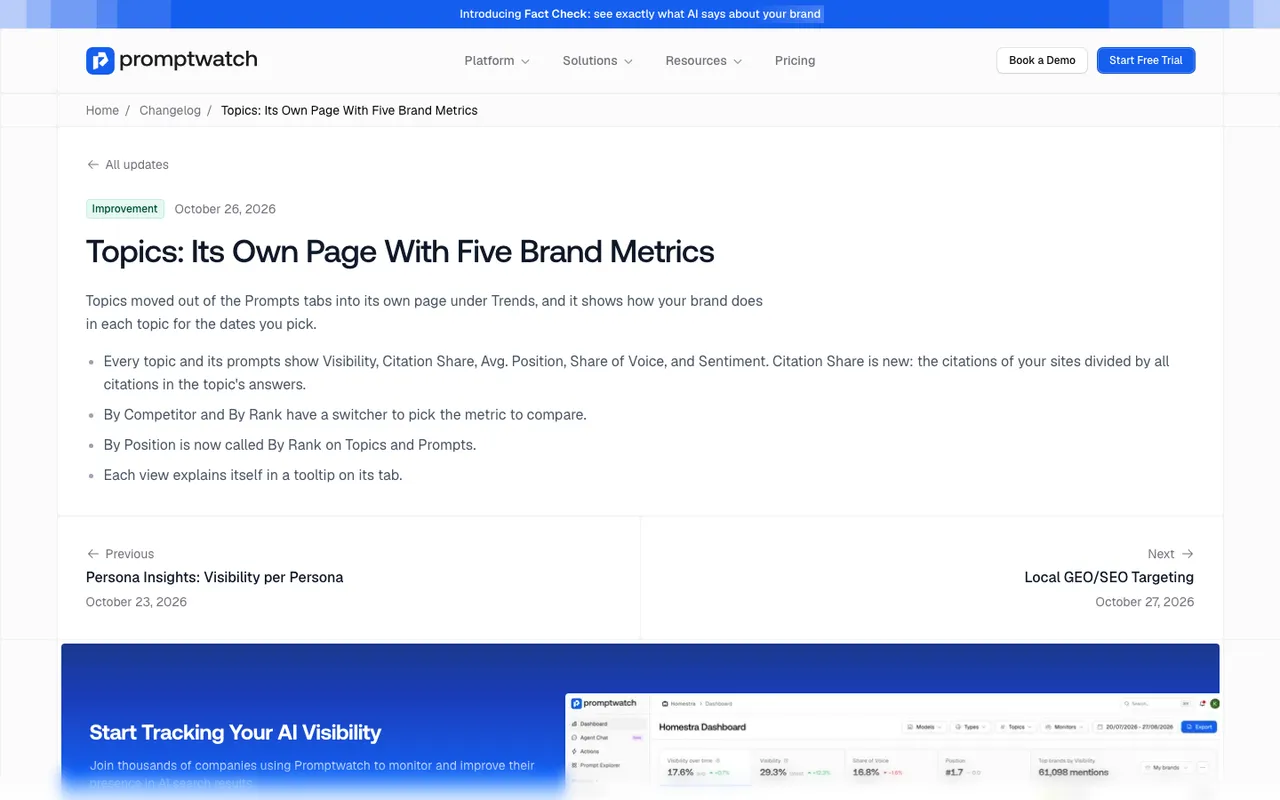 Promptwatch changelog, Topics page with five brand metrics (October 26, 2026), captured November 14, 2026.
Period comparison. A/B period comparison puts the weeks before launch against the weeks after on the same prompts. Trends shows the prompts with the biggest risers and decliners, which tells you where the launch is landing first.
Claims. In Brand Narrative, set the date range to the weeks after launch and look for two things: new claims under Features that mention the new capability, and whether the old "lacks X" claim is repeated less often and by fewer models. The claim's model list tells you which engines have caught up.
Per-model split. Read every metric by model. A rise on Perplexity with no movement on an API model is expected, not a failure.
When the old claim won't go away
If, weeks after launch, an engine still repeats the old limitation, we trace it. Open the claim in Brand Narrative and check its Citations tab for the pages cited alongside it. If one of your own old pages is there, update it. If it's a third-party review or roundup, ask the publisher for an update with a link to the new product page.
On Business, Agency Scale, and Enterprise, Fact Check can mark the old claim Inaccurate and read your site plus up to 50 of the most-cited pages to find which ones still state it. Remember that a check reports what pages say. If an old help article still says the feature is missing, the check will find it, and that's the page to fix.
What not to promise internally
Don't tell leadership that AI "knows" about the launch because one ChatGPT answer mentioned it. Answers vary from run to run. Report the trend: Citation Share in the launch topic, the share of responses that mention the new capability, and which models have caught up. And don't put a date on the API models. Nobody outside the model providers knows when the next training cut will happen.
A launch tracking timeline
| When | What we do |
|---|---|
| Two to four weeks before | Create the topic, add prompts, note current claims, add Page Tracker URLs |
| Launch day | Update landing page, docs, pricing, comparisons, old help articles |
| Week one | Check crawler visits on new pages |
| Weekly, first two months | Topics page metrics, period comparison, Brand Narrative claims, per model |
| When a claim sticks | Trace via Citations, fix own pages, ask publishers |
If you have a launch coming up and want to set the baseline properly, book a Promptwatch demo and ask them to show the Topics page and Brand Narrative on a sample project. Set it up before launch day, not after.