What AI brand perception means for your pipeline
Being named by ChatGPT is not the same as making the shortlist. How AI brand perception shapes pipeline, and how we measure it through to AI-referred conversions.
Picture a demo call that opens well. The prospect says they found you through ChatGPT. Then they add that ChatGPT also described you as "powerful but expensive for a team our size", and the next twenty minutes go to that one sentence. Nobody on your side wrote it, nobody saw it coming, and it set the agenda for the call.
That is AI brand perception reaching your pipeline. Visibility decides whether an engine names you. Perception is what it says once it does: the attributes it attaches, who it says you're for, how it frames you against the alternatives, and the tone it uses. Both matter commercially, but they fail in different ways, and most reporting only covers the first one.
This post is about the commercial side. Where perception shows up between "named in an answer" and "signed contract", what we measure for clients at each step, and what the data can and can't tell a revenue team.
Being named is the start of the funnel, not the end
When a buyer asks an AI engine for options, the answer does two jobs at once. It builds a shortlist, and it pre-qualifies everyone on it. "Acme is a good fit for agencies, though setup takes time" puts Acme on the list and hands the buyer an objection in the same breath. "Acme is mainly built for enterprise teams" can take a small company out of the running before it ever visits your site.
So a mention isn't automatically good for pipeline. A mention with the wrong framing can be worse than no mention, because it gives a confident reason to skip you. When we audit a brand, "are we in the answer?" is only the first question. The second is "would a buyer reading this answer still want to talk to us?"
That second question breaks down into things you can check. Does the answer say who you're for, and is it right? An engine that calls you enterprise-only filters out your mid-market buyers. How does it frame price: expensive, good value, free tier, no trial? Those words turn up in sales calls almost verbatim. In "you vs competitor" answers, are you the default choice or the one with caveats? And is it accurate, or does it describe a retired feature or an old plan as current, which produces a disappointed lead rather than a closed one?
Where perception touches revenue
We see it land in three places. The first is the shortlist itself. If the framing is off, the buyer never clicks, and you never see the lost opportunity in any report. The second is the first sales conversation, where prospects arrive carrying the engine's summary of you and expect you to confirm or correct it. The third is the visit. A buyer who clicked through from an answer that described you well tends to arrive further along than someone browsing, which is one reason AI-referred traffic is worth tracking separately.
Only the third one leaves a clean trace in analytics. The first two you infer from the answers themselves and from what your sales team hears. That's why we treat perception data and traffic data as one picture rather than two reports owned by different people.
How we measure it, in the order we read it
We run client programs on Promptwatch, and we read the metrics in a fixed order. Each one answers a narrower question than the one before.
First, presence. The Visibility Score (0 to 100) says how prominently you appear in answers to tracked prompts, with answers that leave you out counted as zero. Share of Voice says what slice of all brand mentions in those answers is yours. Position says where you land in the order of brands named. These tell you whether you're on the shortlist and how high.
Second, tone. The sentiment score rates how positively answers describe you on a 100-point scale where about 50 is neutral, and it's scored independently of visibility. That independence matters for pipeline: you can be highly visible and still be described in a way that costs deals. Thin mentions, where you're only a name in a list, get no score instead of a fake neutral.
Third, the actual words. Brand Narrative pulls the individual claims engines make about you and your competitors out of tracked responses, groups repeats, and files each claim under one of nine themes: Pricing, Features, Quality, Usability, Range, Support, Reputation, Audience, and Company. Each theme gets a score from 0 to 100 that you can compare with competitors. Brand Narrative is on every Promptwatch plan.
Promptwatch's Academy has a short page on reading these metrics together, and it's the logic we use in client reviews.
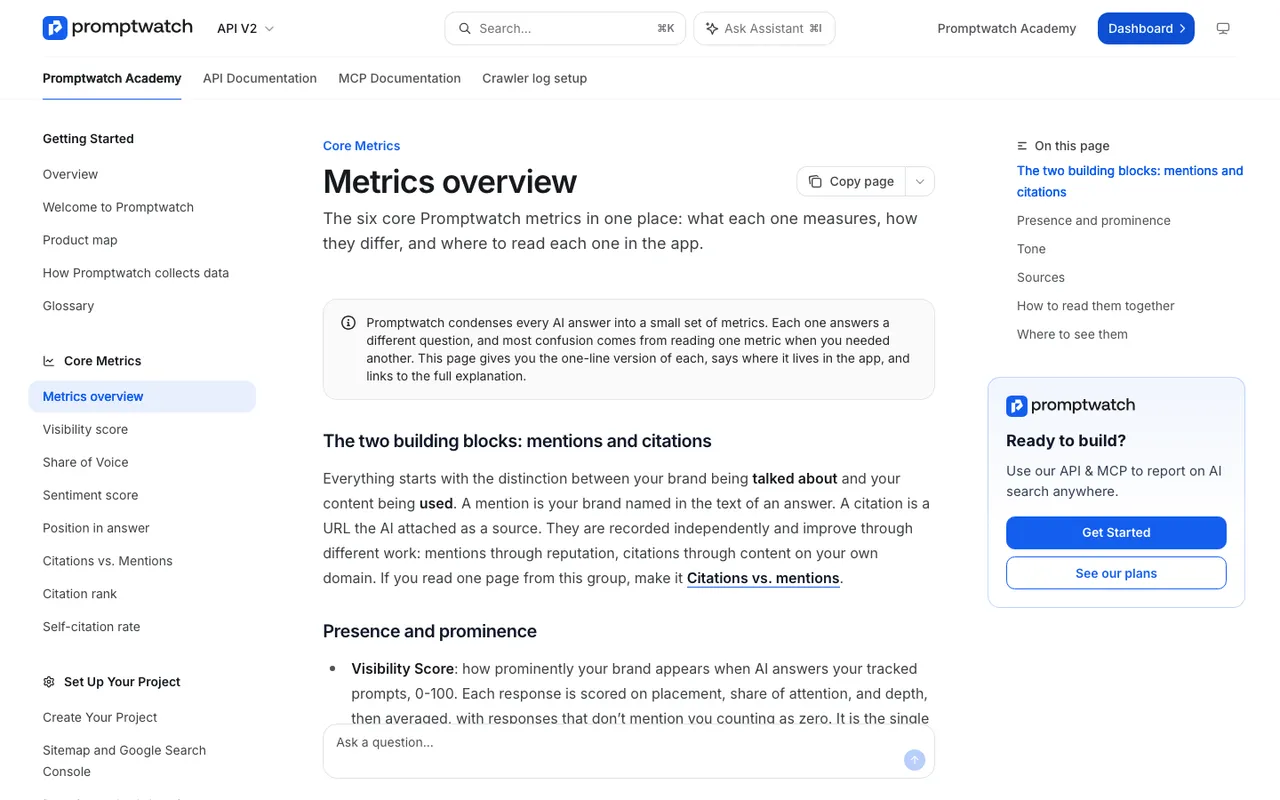 Promptwatch Academy's Metrics overview page, captured November 14, 2026.
The combinations are what locate the problem. Low Share of Voice with a healthy Visibility Score is a coverage problem: you need to get into more answers. Good presence scores with weak sentiment is a reputation problem: you're there, but framed badly. For pipeline, that second pattern is the expensive one, because the dashboard looks fine while sales hears objections.
Mapping themes to deal stages
This is the part revenue teams find most useful. Each Brand Narrative theme maps to a place in the sales process where it causes friction.
| Theme | What a bad version sounds like in an answer | Where it shows up in the pipeline |
|---|---|---|
| Audience | "Best for large enterprises" | Small and mid-size buyers disqualify themselves before visiting |
| Pricing | "Pricey compared with alternatives" | Price objections on the first call |
| Usability | "Steep learning curve" | Longer evaluations, more requests for trials |
| Features | A missing or retired capability | Disappointed demos, churn risk later |
| Support | "Support can be slow" | Late-stage hesitation from procurement |
Read it with your sales team. If the objections they log match the negative claims in a theme, you have a perception problem worth working on. If they don't match, the claim may be rare enough to deprioritize. The claims table shows how often each claim is repeated and by which models, so you can weigh a claim an engine makes daily against one it made once.
Promptwatch's marketing pages make the same point with an example dashboard that compares two brands per attribute for a "startup founder" persona. The numbers in it are illustrations, but the layout shows the idea: perception differs by buyer type, and you can see it per attribute.
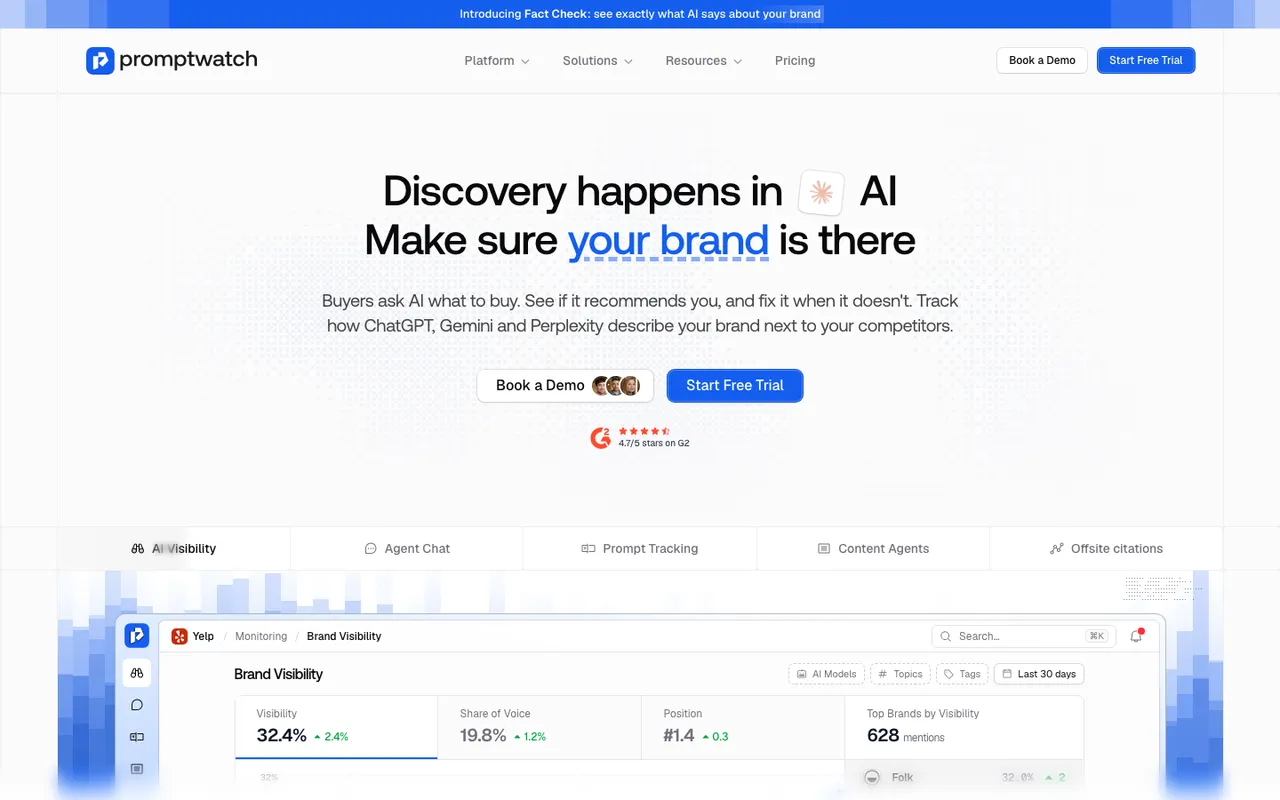 Promptwatch's page for brands, captured November 14, 2026. The dashboard is a product illustration with example data.
Persona Insights does this on your own data: it compares visibility per persona against the general audience. Track prompts with the personas that match your segments and you can see whether, say, finance buyers hear a different story about you than operations buyers.
The attribution gap you need to know about
Perception data tells you what buyers read. Visitor analytics tells you what they did next. Promptwatch's visitor analytics, on every plan, reports AI-referred visits and conversions from ChatGPT, Perplexity, Gemini, Claude, Copilot, DeepSeek, and others, with top pages and locations. It installs through a lightweight script, a Google Tag Manager template, or the WordPress plugin.
One complication. On October 8, 2026, ChatGPT stopped sending a referrer, so its visits started landing in direct traffic for many sites. ChatGPT still adds utm_source=chatgpt.com to links, and Promptwatch added an "Include ChatGPT UTM referrers" toggle that counts those visits as ChatGPT again. A real referrer always wins, so nothing is counted twice. If your AI traffic chart dropped in October and your perception metrics didn't, check that toggle before you report a decline to anyone.
What one published case shows
Promptwatch has published a case study with Crisp, where AI-referred traffic converted at twice the rate of traditional channels. That's Crisp's result, from Crisp's site and audience, not a benchmark for anyone else. We cite it to show that the comparison is worth running on your own numbers, not to predict what you'll find. Our own posts on whether AI traffic converts better than Google traffic go into how to set the comparison up fairly.
What the data can't tell you
It can't tie a single claim to a single lost deal. Nobody's analytics knows that the prospect who went quiet read "expensive for small teams" in Perplexity last Tuesday. What you get is a pattern: a negative theme that persists, sales objections that echo it, and AI-referred conversions that lag in the segments the framing affects. That pattern is usually enough to justify the work.
It also can't guarantee the fix. You can change the pages engines read, both your own and, through outreach, some third-party ones. You can't make an engine say a particular sentence. We tell clients that up front and then measure whether the claim fades in Brand Narrative over the weeks after a change.
A monthly routine for revenue teams
- Pull the negative and mixed claims from Brand Narrative, sorted by how often they're repeated.
- Put them next to the objections your sales team logged that month.
- For overlaps, open the claim's Citations tab to see which pages the answers cited alongside it.
- Fix what you own first, then decide on outreach for third-party pages.
- Check AI-referred conversions per landing page in visitor analytics, with the ChatGPT UTM toggle on.
If you'd like to see this on your own brand before committing to anything, book a Promptwatch demo and ask them to open Brand Narrative and visitor analytics on the same project. Those are the two screens we put in front of revenue teams first.