Which AI visibility tools are built for enterprise SEO teams? Adding AI crawler access and citation work to the SEO you already run
Which AI visibility tools are built for enterprise SEO teams? How an enterprise SEO team adds AI crawler access and citation work to its current stack, where Ahrefs and seoClarity fit, and where Promptwatch does.
An enterprise SEO team already owns most of what AI search needs. It runs log analysis, keeps sitemaps clean, argues with engineering about rendering and reads Search Console every morning. Nobody needs to start from zero.
What changes is two habits. Crawl analysis has to cover AI crawlers, which behave differently from Googlebot. And rank and backlink tracking needs a sibling: citation tracking, because in an AI answer the cited page plays the role a ranking URL plays in a results page. The tools that suit enterprise SEO teams are the ones that slot those two habits into the existing workflow. This post is about how to do that.
What carries over, and what doesn't
Most technical SEO hygiene carries straight over. Pages that load fast, render without JavaScript tricks, sit in the sitemap and get internal links are easier for every crawler. Clear headings and a direct answer near the top help AI engines quote you, just as they help featured snippets.
Three things don't carry over.
The bots are different. AI companies run several crawlers with different jobs. Some collect training data (GPTBot). Some build a search index the engine answers from (OAI-SearchBot, Claude-SearchBot, Meta-WebIndexer). Some fetch a page live because a user asked a question right now (ChatGPT-User, Claude-User, Perplexity-User). A robots.txt written for Googlebot, or a CDN rule written to stop scrapers, can block the ones you need.
Position doesn't map to citation. A page that ranks third in Google may never be cited by ChatGPT, and a page on page two may be cited constantly. You have to measure citations directly.
The traffic signal is weaker. Since October 8, 2026 ChatGPT no longer sends a referrer, so AI visits leak into direct traffic unless your tooling catches the utm_source=chatgpt.com parameter ChatGPT still adds.
Workstream 1: AI crawler access
This is the work technical SEOs pick up fastest, because it looks like log analysis they've done before.
Start with an inventory. List every AI crawler that matters and check, per bot, what robots.txt allows and what the CDN or WAF actually does with its requests. Those two can disagree: a robots.txt that welcomes every AI bot does nothing if the bot-management layer challenges or blocks the same requests.
Then get the logs. At enterprise scale they live at the CDN, which is why integration matters more than dashboards. Promptwatch's Agent Analytics ingests logs from Cloudflare (Logpush or an auto-deployed Worker), AWS CloudFront through Kinesis Data Firehose, Fastly, Vercel and Netlify log drains, Akamai DataStream 2, Google Cloud CDN, a custom HTTP endpoint, or its WordPress plugin.
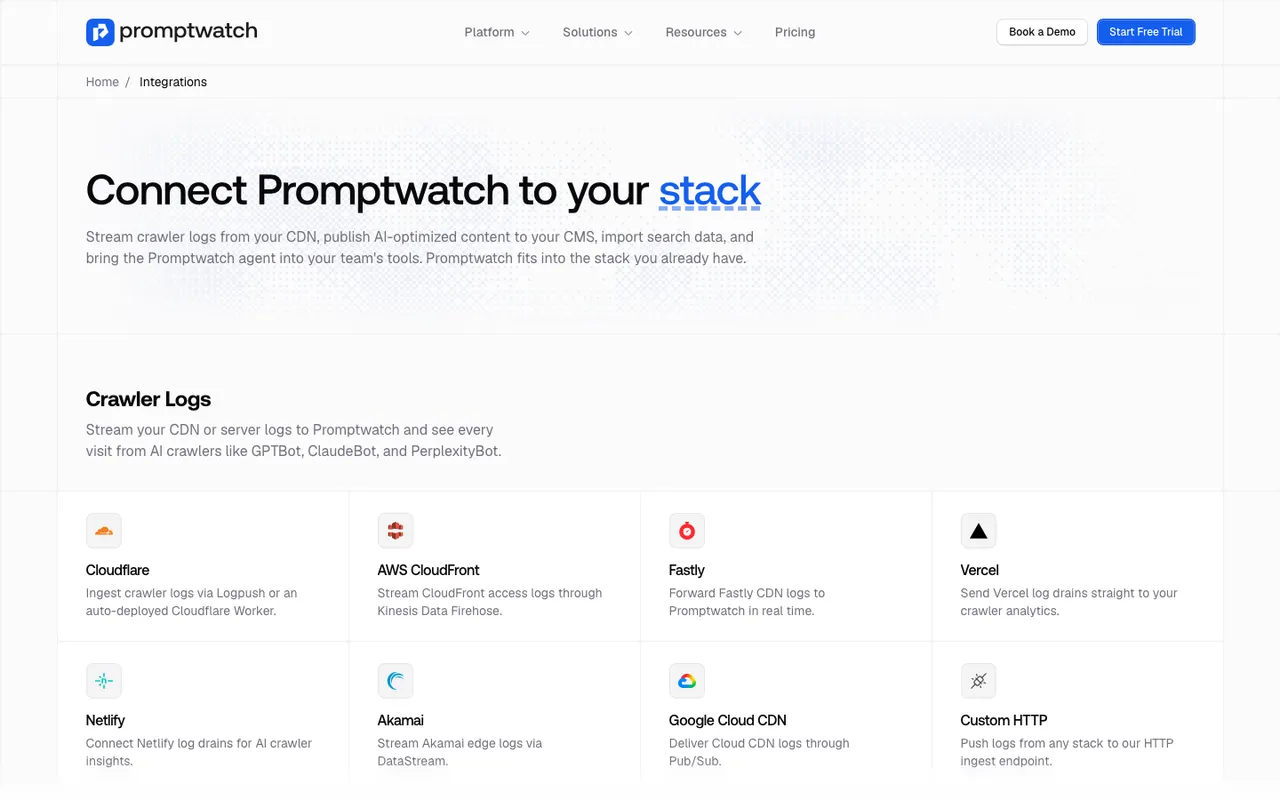 Promptwatch's crawler log integrations, captured November 6, 2026.
Verify before you trust. User agents are easy to fake. Agent Analytics checks each visit against the operator's published IP ranges and drops the spoofed ones, which keeps the numbers honest when someone's scraper claims to be GPTBot.
Then join crawl to citation. The metric we use most is citation rate per page: how often a page that AI crawlers fetch is then cited in answers. A page that's never crawled has an access problem, and that goes to the tech SEO backlog. A page crawled every day and never cited has a content problem, and that goes to the content team. Errors come with explanations, so a 403 for OAI-SearchBot on a comparison guide becomes a ticket with a clear owner.
Two notes from the data. Bot mixes shift fast: Promptwatch reports Meta-WebIndexer grew from about 2% to about 38% of tracked AI crawler requests (Promptwatch data reports), so a bot policy from a year ago may not even name it. And definitions matter. Since November 4, Promptwatch counts search indexers as AI crawls and only live user fetches, like ChatGPT-User, as citation crawls, so expect category totals to move if you compare against older exports.
Workstream 2: citation work
Citation work is the content and digital PR side, and it's closer to link building than most teams expect. You're trying to get specific pages, yours or third-party pages that mention you, into the sources an engine relies on.
Treat cited URLs the way you treat ranking URLs. Promptwatch's URL Positions shows where each URL sits in an answer's source list. Citation rank tells you whether your own domain is a primary source. Self-citation rate shows how much of your visibility rests on your pages as opposed to someone else's. Citation Trends classifies citations into 22 content types and 20 source types, and for individual pages shows when they were first cited, how fast they ramped up and how quickly they decay.
Decay deserves a line in the content calendar. Promptwatch's content half-life report found news loses half its ChatGPT citations within about 36 days. Evergreen guides last longer, but they still need refreshing, and Content Refresh suggests diff-style edits for pages that slip.
Off your own site, offsite mentions list third-party pages that name you without a link, ranked as opportunities. Reddit, YouTube, LinkedIn and Instagram citations each have their own report. That's the brief for digital PR and social teams, written in terms of what the engines actually cite.
Where your existing suite fits
Most enterprise SEO teams already pay for a suite with an AI module. Use it for what it does well.
Ahrefs Brand Radar offers two ways in. Custom Prompts is included with paid Ahrefs plans, with a daily quota of 5 prompts on Lite, 10 on Standard and 20 on Advanced. The AI Visibility Index, a pre-collected database Ahrefs models from its keyword data, starts at $199 a month, with $699 a month shown for all models. Brand Radar also reports AI crawler activity and YouTube and Reddit sources. For a team already living in Ahrefs, it's a quick way to see category-level visibility next to keyword demand.
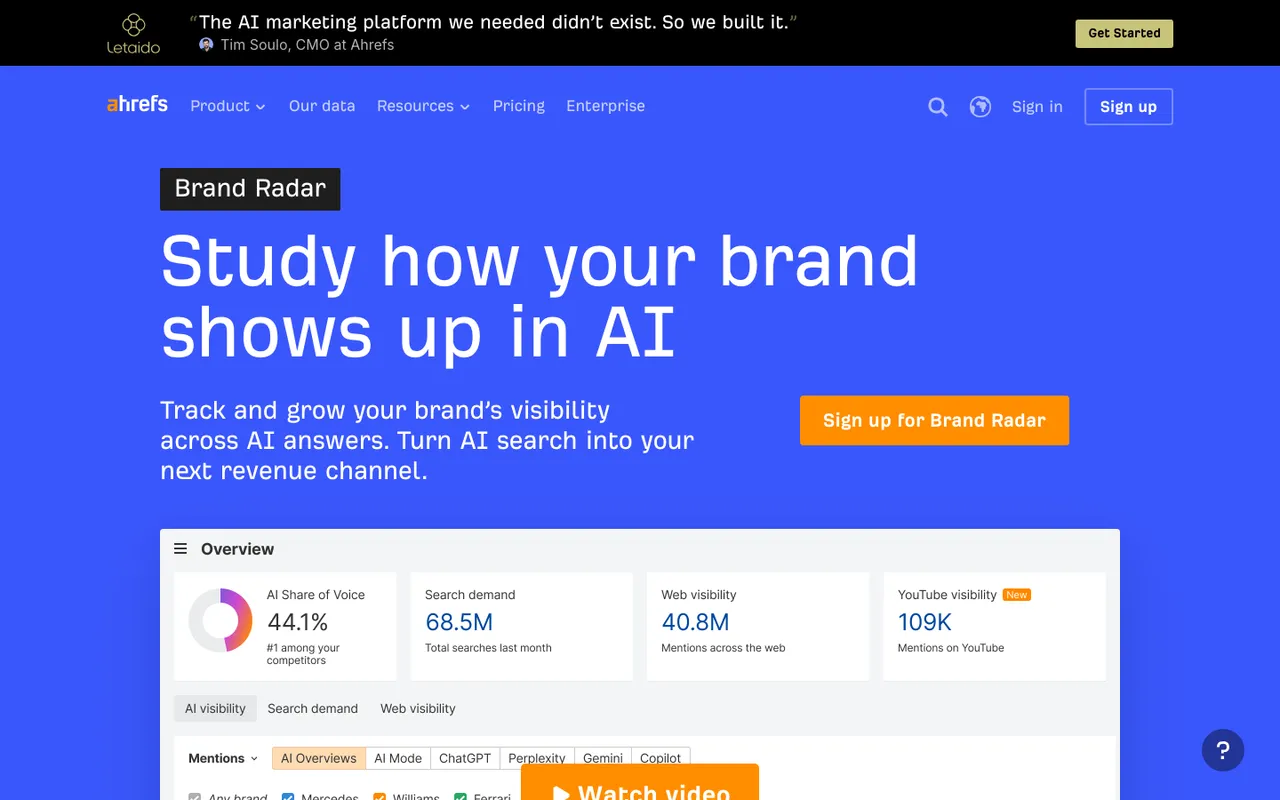 Ahrefs Brand Radar's product page, captured November 6, 2026.
seoClarity sells AI search as Clarity ArcAI, an add-on that lists AI visibility tracking, prompt research, sentiment, AI bot activity, hallucination monitoring, AI shopping capture, and an MCP server and API. Its core packages start at $2,500 a month for Research & Content, $3,200 for Technical and $4,500 for Enterprise, priced by domains and keywords, with ArcAI on its own packages page. The site header says it is SOC 2 audit compliant.
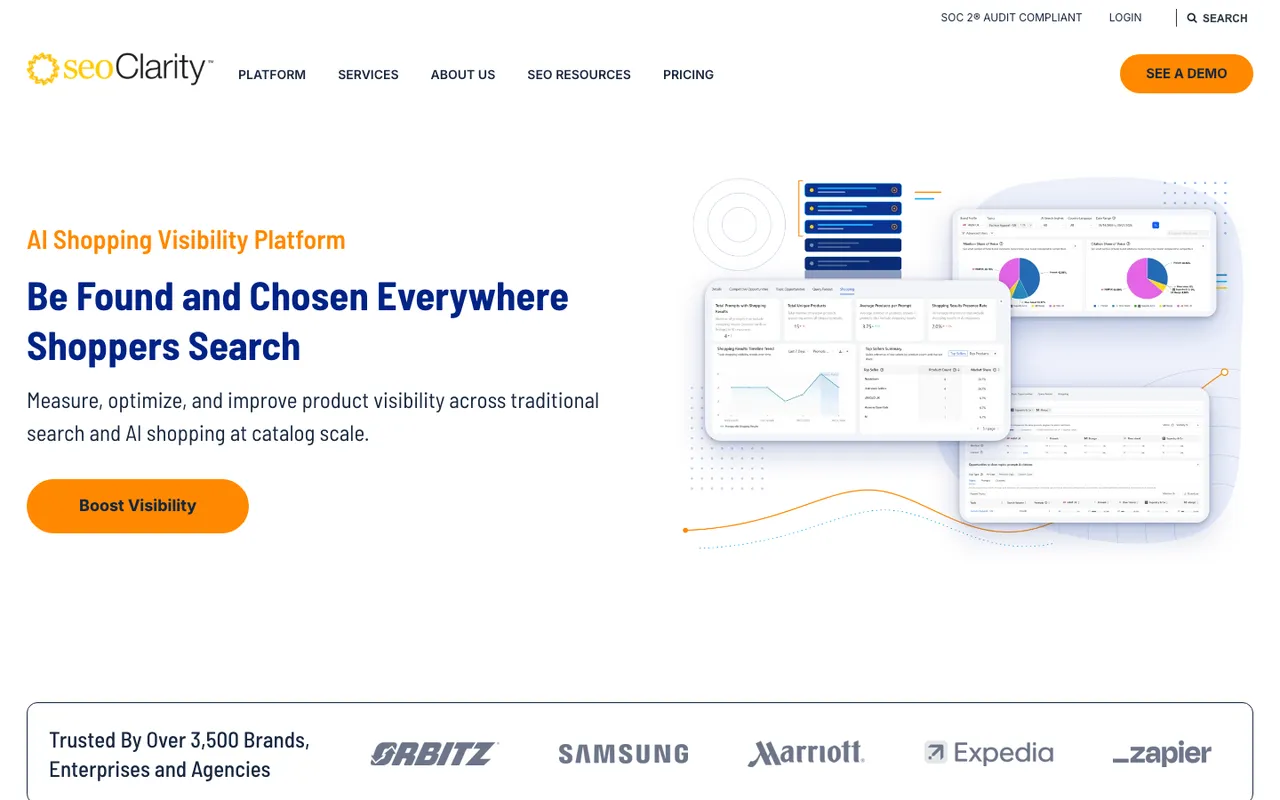 seoClarity's homepage leads with AI shopping visibility, captured November 6, 2026.
Semrush has an AI Toolkit add-on that tracks brand mentions and links in Google AI Overviews, ChatGPT, Gemini and Perplexity. We couldn't confirm its current price against the vendor, so check the live page. Botify, if you already run it, is strong on the delivery side: serving content to agents and rebuilding product feeds for Google and OpenAI.
Our honest read: these modules are good for first visibility numbers next to the keyword data your team already trusts. What they don't put at the center is the per-page join from IP-verified AI crawler logs to citations to AI-referred visits on your own site, with a content loop attached. That's the gap we fill with Promptwatch. It sits next to the suite, not instead of it. Search Insights pulls Google Search Console and Bing Webmaster data (including Microsoft Copilot) into the same per-page and per-topic view as AI crawls, citations and clicks, so the SEO team isn't reconciling two tools by hand.
Who owns what
The org chart matters as much as the tool. This split works for the enterprise teams we support:
- Technical SEO owns crawler access: bot inventory, CDN and WAF rules, crawl errors, the weekly site audit (Promptwatch emails it on Tuesdays) and internal linking for pages AI crawlers skip.
- Content SEO owns citation gaps: content gap analysis, refreshes for decaying pages, new pages for prompts you lose.
- Analytics owns attribution: visitor analytics setup through a script, Google Tag Manager or WordPress, the ChatGPT UTM toggle, and the Looker Studio connector into existing reporting.
- Digital PR and social own offsite citations: the Reddit, YouTube and LinkedIn reports and the offsite mention list.
The Action Board ties it together. Its Discovery agent suggests up to five evidence-backed actions per run, each one can be assigned and discussed, and the digest lands on Mondays. Monks, one of the agencies Promptwatch names, builds dashboards that combine LLM visibility with organic and paid search data for its clients. That's the shape an enterprise SEO report should take once AI search is part of the job.
Which plan an SEO team needs
Crawler logs start on Promptwatch Professional at $245 a month, with 25 million crawler logs, 150 prompts and the Looker Studio connector. Business at $579 raises that to 100 million crawler logs and 350 prompts, adds tracking every 12, 6 or 1 hours and the audit log, and runs site audits on up to 25,000 pages. Enterprise is custom and adds SSO, custom volumes and a dedicated success manager. Every paid plan has unlimited seats, so the whole SEO team can log in.
The practical next step is small. Start the Promptwatch 7-day free trial on monthly billing, connect one CDN log stream in the first two days, and find one page that AI crawlers fetch and never cite. That page is your first ticket. If you want help reading the results, write to hello@visiblyrank.com.